
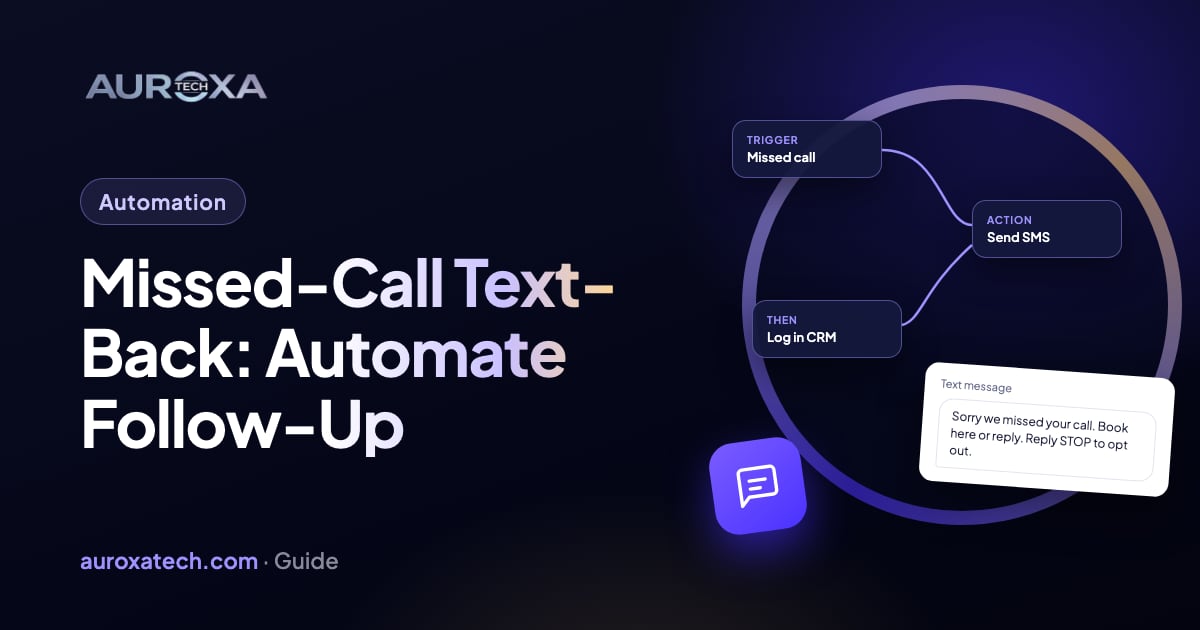
Missed-call text-back sends an automatic text to anyone whose call you didn’t answer, so they can reply or book instead of ringing the next business. You need a phone provider that reports missed calls, such as Twilio, an automation tool such as n8n, Make or Zapier, and a short first message that names your business and explains how to opt out. Check the texting rules where your callers are first: the TCPA and FCC rules in the US, PECR in the UK.
How does missed-call text-back work?
A caller rings your business, nobody picks up, and a moment later they get a text from you: sorry we missed you, here is what happens next. Behind that text are five steps:
- The phone system spots the missed call. The call rings out or hits a busy line, and a programmable phone provider reports it. On Twilio, the Dial instruction that forwards the call sends its outcome, such as no-answer or busy, to a web address you choose. By default it rings for 30 seconds.
- A webhook starts the workflow. That web address belongs to your automation tool, so the workflow runs as soon as the call ends unanswered.
- The workflow checks the caller. Has this number opted out? Did it already get a text today? Is it a customer in your CRM?
- The text goes out from your business number: a callback promise during opening hours, a booking link after hours.
- Replies reach a person, and everything is logged against the contact in your CRM: the call, the text, the reply and any booking.
It is one of the follow-ups we set up as part of workflow automation for service businesses: for home services, a missed call triggers a text with a booking link, and every booked job gets a confirmation and a reminder. A text-back doesn’t answer the call, though; it keeps the caller with you until someone can.
What should the first text say?
The first text has one job: tell the caller who you are and what happens next. Keep it short, use the business name they dialed and give one next step. Three examples:
- During opening hours: “Hi, it’s [Business name]. Sorry we missed your call. We’ll call you back shortly, or reply here with what you need. Reply STOP to opt out.”
- After hours: “Hi, it’s [Business name]. We’re closed right now, but you can book a visit here: [booking link]. Or reply with your question and we’ll get back to you in the morning. Reply STOP to opt out.”
- Clinics and other sensitive services: “Hi, it’s [Practice name]. Sorry we missed your call. Reply here or call us back to book. Reply STOP to opt out.” Leave out the reason for the visit: anyone holding the phone can read the text.
Five rules for the message:
- Put your business name in the first words, so the text isn’t mistaken for spam.
- Keep it about the caller’s own call. A discount or offer turns a customer service reply into marketing, and marketing texts have stricter rules.
- Include opt-out wording such as “Reply STOP to opt out”, and make sure STOP really stops the texts. FCC rules list stop, quit, end, revoke, opt out, cancel and unsubscribe as replies that revoke consent.
- Send one text per missed call, not a sequence. If the caller doesn’t reply, your team calls back.
- Send it from the number they called where your provider allows it, so the reply comes back to you in the same thread.
Is it legal? Consent and opt-out rules in the US and UK
The rules depend on where the caller is, what the text says and how it is sent. Below is what the official sources say. It is a summary, not legal advice: confirm your setup with a lawyer or compliance adviser before you switch it on.
United States: the TCPA, FCC rules and A2P 10DLC
The FCC has said that the Telephone Consumer Protection Act’s restrictions on autodialed calls to cell phones cover texts as well as voice calls, and that a sender who claims consent has to prove it (FCC enforcement advisory). Under the FCC’s rules, automated calls and texts that advertise or telemarket need the recipient’s prior express written consent. People can revoke consent by any reasonable method, including replying “stop”, and the request must be honored within ten business days (47 CFR 64.1200).
There is a carrier requirement too. Twilio’s documentation says anyone sending SMS from an application over a US 10-digit long code number to the US must register for A2P 10DLC: a brand (your business) and a campaign (what you send). Unregistered traffic pays extra carrier fees, and registered traffic gets less filtering. Register before launch.
United Kingdom: PECR and the ICO
In the UK, the Privacy and Electronic Communications Regulations (PECR) treat texts as “electronic mail”. The ICO’s guidance says you must not send marketing texts to individuals without specific consent, unless the “soft opt-in” applies: the person bought, or negotiated to buy, a similar product or service from you, and you gave them a simple way to opt out when you collected their details and in every message since. You must not hide who you are, and you must give a valid address for opting out (ICO: electronic mail marketing).
Messages sent purely for administrative or customer service purposes don’t count as direct marketing, as long as they don’t promote anything (ICO: key concepts). A text that only follows up the caller’s own inquiry is closer to that; add a promotion and it becomes marketing. The ICO notes that its guidance is under review after the Data (Use and Access) Act, so check the current version.
| United States | United Kingdom | |
|---|---|---|
| Main rules | TCPA and FCC rules | PECR, with guidance from the ICO |
| Are texts covered? | Yes: the FCC applies the TCPA’s autodialer limits to texts | Yes: SMS counts as “electronic mail” |
| Marketing texts | Prior express written consent for automated marketing texts | Specific consent, or the soft opt-in for existing customers |
| A reply about the caller’s own call | Keep it free of offers; ask a lawyer whether it needs consent | Purely customer service messages aren’t direct marketing |
| Opt-out | Honor STOP and other reasonable requests within ten business days | Offer an opt-out and act on it promptly |
| Sender registration | A2P 10DLC for application texts from US local numbers | Check your SMS provider’s sender rules |
How to build it with n8n, Make or Zapier
You need a phone provider that reports call events, an automation tool and a way to send SMS. Twilio handles both phone jobs, and n8n has Twilio nodes for triggers and sending. On another cloud phone system, look in its documentation for call webhooks or a built-in missed-call text feature first. Then:
- Get a business number that can send texts, or add texting to the one you have. In the US, register it for A2P 10DLC.
- Create a webhook trigger: a Webhook node in n8n, a custom webhook in Make, or Webhooks by Zapier.
- Point the phone provider at it. In Twilio, the Dial instruction’s action URL receives the call status when the forwarded call ends, and Twilio continues the call with the instructions it gets back, such as a voicemail prompt, so that URL must return those too.
- Filter: continue only when the status is no-answer or busy, the number hasn’t opted out and it hasn’t had a text from you in the last day.
- Send the text through your provider’s SMS step, choosing the opening-hours or after-hours wording.
- Log the call, the text and any reply in your CRM, and alert your team in Slack or by email.
- Add error alerts, then test with your own phone: let a call ring out, hang up early on another, check each text, reply, then reply STOP. Your provider’s documentation says which events fire in each case.
One timing trap: n8n’s Twilio Trigger has an “On New Call” event, but n8n’s documentation warns that Twilio can take up to thirty minutes to generate the summary of a completed call, so that trigger can fire late. A webhook on the Dial result runs as the call ends. If you are still choosing a tool, see our guide to n8n vs Make vs Zapier.
When is an AI receptionist the better fix?
A text-back follows up a call you missed. An AI receptionist answers it. If a missed call often means an emergency, a high-value job or a caller who won’t text, answering beats following up. An AI receptionist usually fits better when:
- Callers need help now: no heat, a leak, a tenant locked out.
- Callers want to book during the call, and your calendar can take the booking.
- Calls arrive in bursts, and several go unanswered at once.
- Your callers rarely reply to texts.
For an HVAC-R contractor we built an AI dispatcher that answers after-hours calls within one ring, routes them across three service lines and sends SMS and email confirmations for every confirmed dispatch. Texts still matter there, as confirmations rather than apologies. The two also work together: the agent answers routine calls, and a text-back covers calls passed to your team that nobody picks up.
Compare the options in our guide to AI receptionist vs answering service, or see how we build them on our AI receptionist page.
How do you know it’s working?
Reply rates depend on your trade, your callers and your wording, so measure your own. Track these each week:
- Missed calls, from your phone provider’s call logs.
- Texts sent and replies received.
- Bookings and callbacks that started from a text.
- Opt-outs. A rising number means the wording or timing needs work.
- Missed calls that got no text, which point to a broken step.
Losing callers who don’t leave a voicemail? We set up missed-call text-back and the follow-ups after it as part of our workflow automation service, and build AI receptionists for calls that need an answer. Contact us to talk it through.
Frequently asked questions
Is it legal to text someone who called my business?
It can be, depending on where the caller is, what the text says and how it is sent. In the US, the FCC applies the TCPA to texts and requires written consent for automated marketing texts. In the UK, purely customer service messages aren’t marketing under PECR. Keep the text about their call, include an opt-out and confirm your setup with a lawyer.
Which phone systems support missed-call text-back?
Any system that can tell another app when a call goes unanswered, through a webhook or an integration. Programmable providers such as Twilio send the result of a forwarded call, including no-answer and busy, to a web address you choose. Other cloud phone systems may offer call webhooks or a built-in missed-call text feature, so check your provider’s documentation.
What reply rate should I expect?
There is no reliable single number: it depends on your trade, why people call, the time of day and your wording. Measure your own. Count missed calls, texts sent, replies and bookings from texts for a few weeks, then test one change at a time, such as adding a booking link.
Sources
- FCC Enforcement Advisory DA 16-1299: text message senders must comply with the TCPA
- U.S. Code of Federal Regulations, 47 CFR 64.1200: consent and opt-out rules for calls and texts
- ICO: electronic mail marketing under PECR
- ICO: key concepts for direct marketing using electronic mail
- Twilio Docs: what is A2P 10DLC?
- Twilio Docs: TwiML Dial verb (action URL and DialCallStatus)
- n8n Docs: Twilio Trigger node