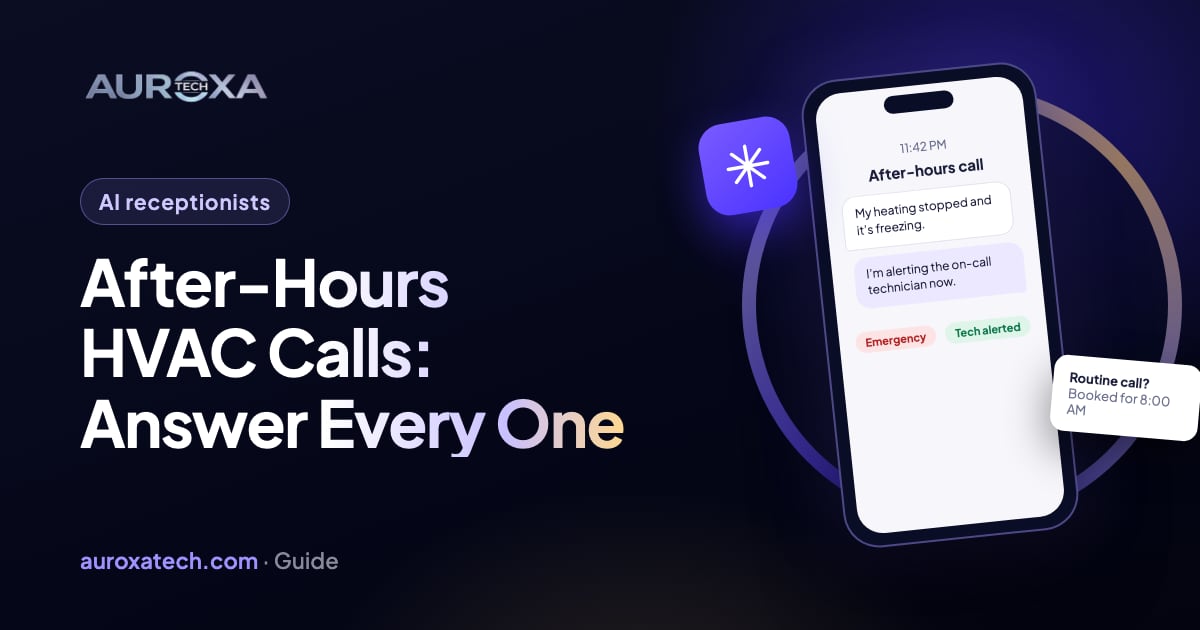
Write down what counts as an emergency, then let an AI dispatcher answer every after-hours call in one ring: it sorts urgent from routine, alerts the on-call technician for real emergencies, gives safety instructions where needed and books everything else into the next open slot. Your team starts the day with booked jobs, not voicemails.
Why after-hours calls matter in HVAC
HVAC demand doesn’t keep office hours. A furnace fails on the coldest night, an air conditioner on the hottest weekend, and those calls are urgent for the person making them. When the call goes to voicemail, the caller rarely waits for a callback: they try the next company in the search results.
Most companies cover nights with a technician’s mobile, an answering service that takes messages, or voicemail. Each leaves a gap: the technician can’t answer while working, messages still need someone to book them in the morning, and voicemail loses the caller who wanted an answer now.
Step 1: Decide what counts as an emergency
Everything else depends on this list, so write it down with your team. A typical set of rules:
- No heat in freezing weather, or no cooling in extreme heat when the household includes babies, older people or someone unwell: emergency, alert the on-call technician now. The CDC calls air conditioning the strongest protection against heat-related illness.
- Gas smell: safety first. Federal pipeline safety guidance says not to use phones or switches near a leak, to leave the area and to call 911 from well away. The agent tells the caller to hang up, leave the building and call 911 and the gas utility from outside, then alerts your on-call technician.
- Carbon monoxide alarm or symptoms: the agent tells the caller to get outside to fresh air and call 911, as the US Consumer Product Safety Commission advises, then alerts the on-call technician.
- Water leaking from equipment: urgent; book the first slot and give the caller the steps you approve, such as switching the unit off.
- Everything else, such as noisy units, weak airflow, maintenance and quotes: book into the next open slot.
Step 2: Map your service lines and who is on call
If you run residential, commercial and property-management work, each line may have its own technicians, rates and booking windows. List them, the areas each one covers and the on-call rota, so the agent can send each call to the right place without a dispatcher.
Step 3: Decide what gets booked tonight and what waits
- Emergencies: alert the on-call technician by call and text, and tell the caller what happens next.
- Urgent but safe: book the first slot in the morning and send a confirmation.
- Routine and maintenance: book into the normal schedule.
- Returning customers: look them up first, so the same job isn’t booked twice.
What an AI dispatcher handles
- Answers every after-hours call within one ring, including several at once.
- Asks the questions your dispatcher would ask and sorts the call by your rules.
- Routes it to the right service line and alerts the on-call technician for emergencies.
- Books the job and sends SMS and email confirmations.
- Logs every call with a summary in your CRM or scheduling tool.
It shouldn’t diagnose equipment, promise prices you haven’t set or argue with an upset customer. Those calls go to a person, and you decide the rules.
Voicemail, answering service or AI dispatcher?
| Voicemail | Answering service | AI dispatcher | |
|---|---|---|---|
| Answers | No one | A person, when one is free | Every call, within one ring |
| Emergencies | Heard the next morning | Passed on by message or call | On-call technician alerted during the call |
| Bookings | None | Messages, sometimes a calendar booking | Booked into your schedule with a confirmation |
| Your systems | Nothing updated | Messages to process in the morning | CRM and schedule updated |
If your field service software already offers AI call answering
Several field service platforms now offer their own AI phone features. If yours does and it covers your call types, try it first: it is already connected to your jobs and customers. A custom AI dispatcher makes sense when you need routing across several service lines, emergency rules of your own, duplicate-booking checks, or connections to tools outside the platform. We connect through each platform’s integrations or API, or through an automation tool, and confirm what is possible before quoting.
Case study: one ring, three service lines
A multi-line HVAC-R company serving residential, commercial and property-management accounts sent its after-hours calls to voicemail, and dispatching across three service lines needed a person on the phone. The AI dispatcher we built answers every after-hours call within one ring, routes it to the right line, checks returning callers to avoid duplicate bookings and confirms each dispatch by SMS and email. The voice flow was refined more than 20 times from real calls.
What to prepare before you start
- Your service lines and the areas each one covers.
- Your emergency rules and the on-call rota.
- Booking windows and how long each job type takes.
- Access to your scheduling tool or CRM.
- A few recent call recordings or notes, so the voice flow matches how your customers talk.
Frequently asked questions
Can an AI receptionist alert our on-call technician?
Yes. Emergency calls follow the rules you set: the agent can call or text the on-call technician, pass on the caller’s details and tell the caller what happens next.
Will it work with ServiceTitan, Jobber or Housecall Pro?
We connect through each platform’s integrations or API where they are available, or through an automation tool such as n8n or Zapier. We confirm what your account allows before quoting.
What if the caller asks for a person?
The agent transfers the call or takes the details for a callback, depending on your rules and who is on call.
Should it answer daytime calls too?
Many HVAC companies start with after-hours and overflow calls, then decide from the transcripts whether to extend it to daytime calls.
Sources
- PHMSA: Recognizing and responding to pipeline emergencies (gas leak do’s and don’ts)
- U.S. Consumer Product Safety Commission: Carbon Monoxide Information Center
- CDC: Heat and health tracking (air conditioning and heat-related illness)
- U.S. Bureau of Labor Statistics: HVAC mechanics and installers (evening, weekend and on-call work)
- Auroxa Tech case study: AI voice dispatch for an HVAC-R contractor