
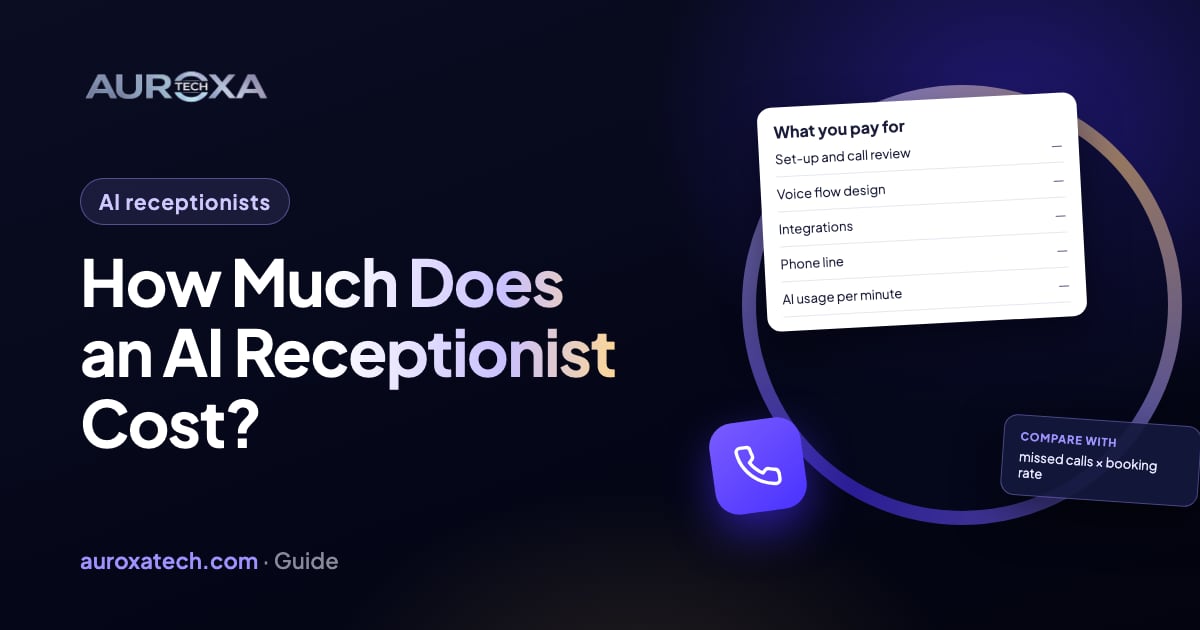
An AI receptionist has two kinds of cost: a one-off set-up, which pays for the voice flow, the connections to your calendar and CRM, and testing; and running costs that grow with your calls, mainly per-minute charges for the voice AI platform and the phone line. Subscription tools cost less to start but fit fewer processes, while a custom build costs more up front and follows your own rules. To judge the price, compare it with what missed calls, extra staff hours or an answering service cost you at your own call volume.
What are you paying for?
Every AI receptionist price is built from the same parts, whether you buy a subscription tool or a custom build. Some are paid once, some monthly and some for every minute a caller is on the line.
| Cost | How it is paid | What it covers |
|---|---|---|
| Set-up and call review | Once | Mapping your call types, your busiest hours and which calls must always reach a person |
| Voice flow design | Once, then small changes | The questions, answers and routing rules the agent follows, written from your business information |
| Integrations | Once, plus upkeep | Booking into your calendar or scheduling tool, CRM updates, SMS and email confirmations |
| Phone line | Monthly and per minute | A phone number, or forwarding from your existing one, and the carrier charge for every minute of every call |
| AI usage | Per minute | Speech recognition, the language model and the synthetic voice, for every minute of every call |
| Tuning and support | Monthly or as needed | Reviewing transcripts, fixing answers and adding call types |
Set-up costs depend on how many call types and systems you have; usage depends on how many minutes callers spend on the phone. Our AI receptionist and voice agent service page shows how the steps fit together, from call review to launch.
Phone charges
Calls carry phone charges before any AI is involved. Twilio’s US voice pricing page lists $0.0085 a minute to receive a call on a local number, $0.0140 a minute to call a US number, and $1.15 a month for a local number. Twilio’s conversational AI pricing lists its ConversationRelay voice AI layer at $0.07 a minute, with voice costs billed separately. These are Twilio’s published prices, marked current as of August 2026 and checked in October 2026; prices change.
AI usage charges
Voice AI platforms price the agent itself by the minute too. Retell AI’s pricing page lists $0.07 to $0.31 a minute for AI voice agents and breaks that price into its voice infrastructure, the language model, the text-to-speech voice and telephony. It says each call is tracked to the nearest second and that billing covers the whole call, including silence. It is a published price, checked in October 2026, that will change; we show it to explain the pricing model, not as a quote.
Should you choose a subscription tool or a custom build?
A subscription tool gives you a ready-made agent that you set up yourself, within the options it offers, for a monthly fee. A custom build is designed around your calls and systems by a team like ours: you pay for the set-up, then for platform and phone usage.
| Subscription tool | Custom build | |
|---|---|---|
| Up-front cost | Low: you set it up yourself | Higher: voice flow, integrations and testing are built for you |
| Monthly cost | The plan fee, plus any usage the plan charges for | Platform and phone usage, plus any support you agree |
| Fits your process | Within the options the tool offers | Follows your rules: service lines, urgent calls, intake questions |
| Integrations | The calendars and CRMs the tool supports | Your scheduling tool, CRM or field service platform, through its API or an automation tool |
| Who tunes it | You | The builder, from real call transcripts |
| Fits best when | Calls are simple and your tools are on its list | Calls need sorting, several systems or rules of your own |
A subscription tool suits simple messages and bookings in a calendar it already supports. A custom build earns its set-up cost when calls have to be sorted, booked into a specific system or handled under your own rules, such as routing across three service lines on our HVAC dispatch project or two-way CRM and scheduling sync on our clinic patient intake agent. Our guide to AI receptionist software covers the features to look for in either case.
What makes an AI receptionist cost more or less?
- Call volume and length. Usage is billed by call time, so more calls and longer calls cost more. A short booking call costs less than a long question-and-answer call.
- Number of call types. Each extra call type, service line or location adds questions, rules and test scenarios to the voice flow.
- Integrations. A shared calendar is quicker to connect than a clinical CRM or field service platform, and some systems need n8n, Make or Zapier in between.
- Voice and model choice. On Retell’s published price list, its own voices and several others cost $0.015 a minute, ElevenLabs voices $0.04 to $0.10 a minute, and the language model price varies by model.
- Outbound calls. Reminder and follow-up calls add minutes and bring consent rules to check with your adviser.
- Regulated data. Healthcare and finance add design work: what the agent may say and store, caller verification and contracts with each vendor.
- Tuning. The first weeks after launch need transcript reviews. On our HVAC project the voice flow was refined more than 20 times from real calls.
- Busy periods. Platforms can limit how many calls run at once: Retell’s published pricing includes 20 concurrent calls, then charges $8 a month for each extra one.
How do you compare the cost with the calls you miss today?
A price only means something next to what you lose now. Work it out with four of your own numbers, all from records you already keep:
| Your number | Where to find it |
|---|---|
| A. Missed calls a month | Your phone provider’s call logs: unanswered calls and voicemails, including evenings and weekends |
| B. Share of missed calls that were new business | Listen to a sample of voicemails, or call a sample back |
| C. Share of answered new-business calls that book | Your CRM or booking records |
| D. Average value of a booking or job | Your invoices or accounting software |
- Value at risk each month = A × B × C × D. Some callers would have tried again, so treat this as the most that answering every call could win back.
- Running cost each month = calls a month × average call length in minutes × the combined per-minute rate for AI and phone, plus phone numbers and any support fee.
- Set-up cost each month = the set-up price divided by the number of months you expect to use the agent.
- Compare. If the value at risk is clearly larger than steps 2 and 3 together, an AI receptionist is worth testing. If the numbers are close, start with after-hours calls only and measure.
Compared with hiring a receptionist
A receptionist is paid for every hour on shift, busy or quiet. The US Bureau of Labor Statistics gives a 2025 median pay for receptionists of $18.27 an hour, or $38,010 a year, and says most work full time. Wages are only part of the cost: in the BLS employer costs survey for June 2026, wages and salaries made up 70.0 percent of private-industry employers’ compensation costs, and benefits the other 30.0 percent.
A person also greets visitors, handles paperwork and deals with situations no script covers, so compare the AI with the extra hours you would pay for just to answer the phone: evenings, weekends and peak times.
Compared with an answering service
Connections Magazine, an industry trade magazine, describes answering services billing some accounts at a flat rate, others per call and others per minute, with some also charging for transfers or for wrap-up work after the call. Ask for a quote at your real call volume and compare the outcome too: a message for your team, or a finished booking. Our guide on AI receptionist vs answering service compares the two in detail.
What should you ask before you buy?
- What exactly does the set-up cover: call review, voice flow, which integrations and how many test scenarios?
- How is usage billed? Per minute or per second, and do hold time, silence and transferred calls count?
- Are phone numbers and carrier minutes included, or billed separately?
- Who reviews transcripts and tunes the voice flow after launch, and is that in the monthly fee?
- What does it cost to add a call type, an integration or a language later?
- Who owns the voice flow, the prompts and the call data, and can you export transcripts if you leave?
- For healthcare or finance, will every vendor sign the contracts your rules require? Our guide to medical answering services vs AI receptionists covers this for clinics.
- What will you measure after launch: calls answered compared with calls missed before, appointments booked, calls transferred and questions the agent couldn’t answer?
Want a figure for your own calls? We quote after a short call about your setup, because the price depends on call volume, the number of call types and the systems we connect. See how we build them on our AI receptionist page, or contact us with your call volume and the tools you use.
Frequently asked questions
Is an AI receptionist cheaper than hiring a receptionist?
It depends on what you need the person for. A receptionist is paid for every hour on shift: the US median wage was $18.27 an hour in May 2025, before benefits. An AI receptionist is billed mainly per minute of calls, plus set-up. For after-hours and overflow calls it can cost less than paying for extra shifts; for front-desk work beyond the phone, you still need people.
Are there per-minute charges?
Usually, in two layers: the voice AI platform and the phone line. For example, Twilio lists $0.0085 a minute to receive a US call on a local number, and its ConversationRelay voice AI layer at $0.07 a minute, with voice billed separately. Those are published prices checked in October 2026, and they change. Ask how minutes are rounded and whether hold time counts.
What does set-up involve?
Set-up turns the way you handle calls today into a working agent. It covers a review of your call types, the voice flow and routing rules, connections to booking, confirmations and your CRM, and tests with real call scenarios before launch. After launch the flow is tuned from transcripts. More call types and systems mean more set-up work.
Do you publish a price list?
No. We quote after a short call about your setup, because the price depends on call volume, the number of call types or service lines and the systems we connect. Whoever you ask, get the one-off set-up and the running costs as separate lines, so you can compare quotes like for like.
Sources
- U.S. Bureau of Labor Statistics: Occupational Outlook Handbook, Receptionists (pay and work schedules)
- U.S. Bureau of Labor Statistics: Employer Costs for Employee Compensation, June 2026
- Twilio: US voice pricing (per-minute call and phone number prices)
- Twilio: conversational AI pricing (ConversationRelay per-minute price)
- Retell AI: pricing (per-minute voice agent pricing model)
- Connections Magazine: how answering services bill (flat rate, per call, per minute)
- Auroxa Tech case study: AI voice dispatch for an HVAC-R contractor