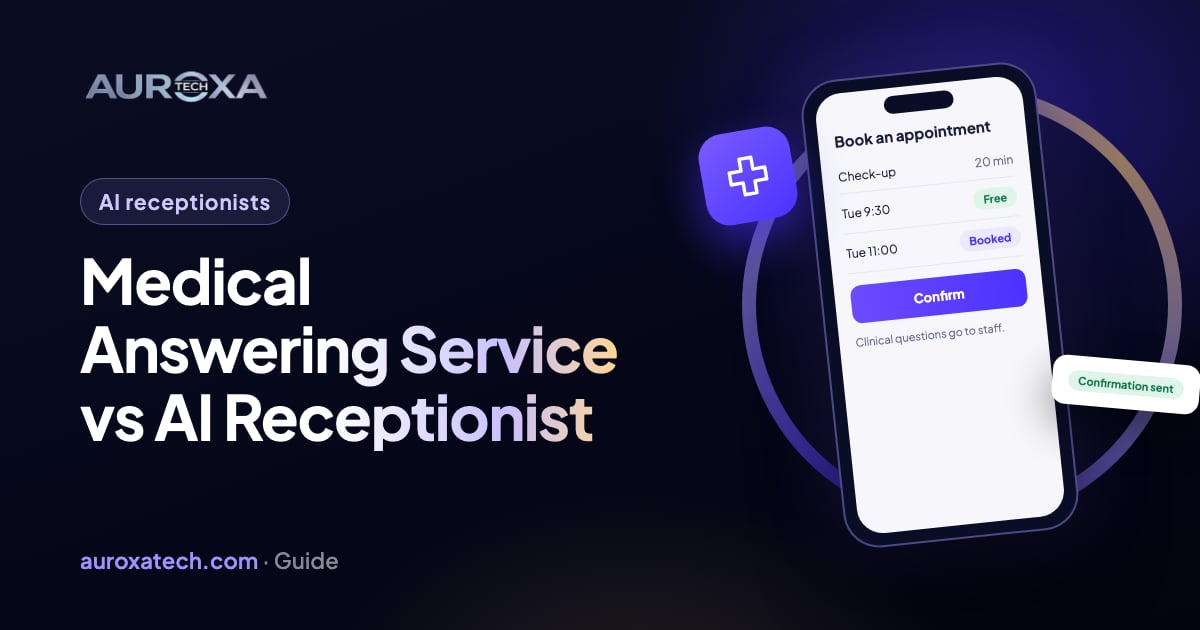
A medical answering service puts a person on your phones to take messages and pass urgent calls to the clinician on call. An AI receptionist answers every call at once and finishes routine tasks during the call, such as booking, rescheduling and confirming appointments in your schedule, but it never gives medical advice. A practical set-up lets AI handle scheduling calls and keeps people, or the answering service, for anything clinical or urgent.
What does a medical answering service do?
A medical answering service is a team of operators who answer your practice’s phone when the front desk can’t: after hours, at lunch and when every line is busy. O*NET, the US Department of Labor’s occupation database, describes the work of answering service operators as answering calls, providing information, transferring calls or taking messages, relaying messages and paging people about their calls.
For a clinic, that usually means taking the patient’s details and the reason for the call, sending routine messages to the front desk for the morning, and passing urgent ones to the clinician on call. US patient guidance from MedlinePlus tells patients that when the office is not open, their call may be forwarded to a nurse or other provider who is on call for the clinic.
The strength of an answering service is the person on the line, who can calm a worried patient and use judgment. The limit is that most calls end as a message: someone still has to call the patient back and book the appointment. For the same comparison outside healthcare, see our guide on AI receptionist vs answering service.
What does an AI receptionist add?
An AI receptionist is a voice agent that answers in your practice’s name and completes the routine task while the patient is on the line. For a clinic or dental office, that means:
- Booking new appointments against live availability, by appointment type and provider.
- Rescheduling and cancelling, so a freed slot is back in the schedule straight away.
- Confirmations by SMS or email, and reminders before the visit.
- Answers to common questions about services, opening hours and location.
- Outbound calls, for example to invite lapsed patients back.
- A transcript and summary of every call for your team, and a transfer to a person when the call needs one.
On our clinic patient intake project, patients book, reschedule and confirm appointments by voice, every change is written to the clinic’s CRM and scheduling platform, and outbound calls invite lapsed patients back. Every new feature starts with a written change order, so the clinic always knows what the agent does. Our AI receptionist for clinics page shows how we set the same flows up for dental, medical and wellness practices.
Which calls must always go to staff or emergency services?
An AI receptionist must never give medical advice. It doesn’t assess symptoms, interpret results or suggest treatment. Your practice decides in writing which calls go where, and a clinical lead should sign off the list before launch.
| Call | Who handles it | What the agent does |
|---|---|---|
| Book, move or cancel an appointment | AI receptionist | Completes it in your schedule and sends a confirmation |
| Opening hours, location, services offered | AI receptionist | Answers from information you approved |
| Symptoms, “should I come in?”, medication or test results | Staff or the on-call clinician | Takes the details and transfers the call or books a callback, by your rules |
| A possible emergency, such as signs of a heart attack or stroke | Emergency services | Tells the caller to hang up and call 911 or 999 now, then alerts staff if your rules say so |
| Upset patient, complaint or billing dispute | A person | Transfers the call or takes details for a callback |
| Caller asks for a person | A person | Transfers or takes details, whatever the topic |
Write the emergency rule with your clinicians and keep it simple. MedlinePlus says that if a person could die or be permanently disabled, it is an emergency, and to call 911 or the local emergency number. In the UK, the NHS says 999 is for life-threatening emergencies such as strokes and heart attacks, and that NHS 111 can check symptoms and tell people what to do.
The agent repeats the instruction your practice approved rather than judging how serious a symptom is. When it is unsure, it treats the call as urgent and hands it to a person.
How is patient privacy handled?
An answering service and an AI receptionist both hear names, dates of birth and reasons for visits, so the same privacy rules apply to each. Below is what official guidance says. It is not legal advice: confirm how it applies to your practice with your compliance adviser or lawyer.
In the US: HIPAA
Health care providers that submit HIPAA transactions, like claims, electronically are covered entities, and CMS lists doctors, clinics and dentists among them. CMS’s HIPAA guidance describes a business associate as a vendor or subcontractor who has access to protected health information (PHI), and says the HIPAA Rules require covered entities and their business associates to enter into contracts or business associate agreements (BAAs).
In practice, an outside answering service or AI receptionist vendor that handles PHI for you is a business associate and needs a BAA. CMS adds that the contract must set out what the business associate has been engaged to do and require it to comply with HIPAA. Ask about the whole chain, too: the phone platform, the voice AI platform and any tool that stores recordings or transcripts.
In the UK: UK GDPR
The ICO lists data concerning health as special category data: personal data that needs more protection because it is sensitive. To process it you need a lawful basis under Article 6 of the UK GDPR and a separate condition under Article 9, and you need a data protection impact assessment (DPIA) for any processing likely to be high risk.
When a vendor processes personal data for your practice, the ICO says there must be a written contract between you, the controller, and the vendor, the processor. The ICO notes that this guidance is under review after the Data (Use and Access) Act, so check the current version.
Whichever rules apply, raise them at the start. For healthcare work we agree the scope in writing, keep a change order for every new feature and design the data flow around the rules you name, such as HIPAA or UK GDPR.
What does a mixed set-up look like for a clinic?
You don’t have to pick one. A mixed set-up that keeps people on the calls that need them looks like this:
- The AI receptionist answers first, after hours and whenever the front desk is busy.
- Scheduling calls are finished during the call: booked, moved or cancelled, with a confirmation.
- Clinical questions go to the front desk as a callback in opening hours, and to your answering service or on-call clinician after hours.
- Anyone describing a possible emergency hears the 911 or 999 instruction straight away.
- Staff review transcripts weekly in the first weeks and adjust the rules.
Daytime calls can stay with your front desk until the transcripts show the agent handles them well. The front desk then spends less time on the phone and more with the patients in the room.
Checklist: what to settle before you choose
- Your call volume by hour and day from your phone system, including missed calls and voicemails.
- The share of calls that are scheduling, general questions, clinical questions and emergencies.
- A written list of what goes to staff, to the on-call clinician and to emergency services, signed off by a clinical lead.
- Your appointment types, how long each takes and which provider offers it.
- Access to your scheduling platform and CRM, and whether they offer an integration or API.
- A BAA (US) or a written processor contract (UK) with every vendor that will handle patient data, and a DPIA where UK GDPR requires one.
- Where recordings and transcripts are stored, for how long, and who can open them.
- How the agent introduces itself, and how a patient reaches a person at any point in the call.
- Test calls for every scenario before launch, including emergencies and callers who ask for a person.
- For outbound reminder or reactivation calls, the consent rules that apply to you, checked with your adviser.
Thinking about an AI receptionist for your practice? See how it works on our AI receptionist for clinics page and our wider AI receptionist and voice agent service, or contact us to walk through how the agent would handle your patient calls.
Frequently asked questions
Can an AI receptionist give medical advice?
No. An AI receptionist handles scheduling and general questions, such as opening hours and location. Questions about symptoms, medication or test results go to your staff or the on-call clinician, and a caller describing a possible emergency is told to hang up and call 911 or 999. Your practice writes these rules, and they are tested before launch.
Is patient data safe with an AI receptionist?
It can be, if the vendors and the set-up meet the rules for your practice. In the US, a vendor with access to protected health information is a business associate and needs a business associate agreement. In the UK, health data is special category data, and a processor needs a written contract. Ask where recordings are stored and who can open them, and confirm the details with your compliance adviser.
Does an AI receptionist work for dental offices?
Yes. Dental offices use the same core flows as medical practices: booking and rescheduling, confirmations and reminders, and questions about services and opening hours. What changes is the list of appointment types, how long each takes and which questions always go to the team, such as pain after treatment. In the US, dentists who submit claims electronically are HIPAA covered entities too.
Can we keep our answering service and add an AI receptionist?
Yes. One workable set-up lets the AI receptionist answer first and finish scheduling calls, while clinical questions and urgent after-hours calls go to your answering service or the on-call clinician. The routing rules are part of the voice flow, so you can move call types between them as you review transcripts.
Sources
- O*NET OnLine: Switchboard Operators, Including Answering Service (43-2011.00)
- MedlinePlus (U.S. National Library of Medicine): When to use the emergency room, adult
- NHS: When to call 999
- CMS: Are you a covered entity? (HIPAA covered entities and business associate contracts)
- CMS Information Security and Privacy: HIPAA, business associates and BAAs
- ICO: Special category data (UK GDPR)
- ICO: When is a contract needed between a controller and a processor?